

Spiral wound gaskets are high-performance sealing solutions engineered for demanding industrial environments where pressure, temperature, and chemical exposure exceed the limits of conventional soft gaskets. Constructed from a combination of metallic windings and soft filler materials, they provide a controlled balance of strength, resilience, and conformability.
Widely specified across oil & gas, petrochemical, power generation, and process industries, spiral wound gaskets are particularly suited to flanged joints subject to thermal cycling, pressure fluctuations, and mechanical stress. Their design enables reliable sealing performance in both standard and critical service conditions, including high-pressure pipelines and heat exchangers.
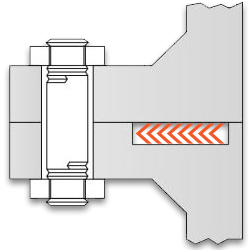
Spiral gasket only

Gasket with guide ring to act as a compression stop

Gasket with inner ring
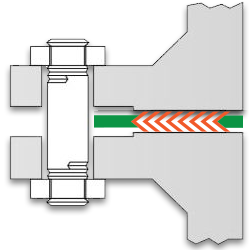
Standard gasket with inner ring and outer rings

Special gasket for RTJ flanges

For large diameter heat exchangers

As HX-R but with inner ring
Where an undesirable reaction between graphite and the medium to be sealed occurs, a spiral wound gasket with a GT-Zone can be effective in producing a seal that will not pollute medium and gives excellent gas tightness.
The material construction of a spiral wound gasket is based upon the required operating conditions, typically temperature, pressure and substance. For example, a typical standard spiral wound gasket could be made up of a 316 Stainless Steel inner ring and winding with a graphite filler, and a carbon steel outer ring.
To allow for various chemical compatibilities and pressure/temperature requirements, a selection of filler materials are available, including graphite, PTFE, Non-asbestos and Mica.
| Filler Materials | Temperature Range | Max BAR | Chemical Compatibility | Colour Coding |
| Graphite | min -200 max 550 °C | 250 bar | Very Good | Grey Stripe |
| PTFE | min -200 max 250 °C | 100 bar | Excellent | White Stripe |
| Non- asbestos | min -100 max 250 °C | 100 bar | Good | Pink Stripe |
| Mica | min -200 max 1000 °C | 100 bar | Moderate | Light Green Stripe |
| Winding Materials | Temperature Range | Max BAR | Colour Coding |
| 304 Stainless Steel | min -250 max 550 °C | 172 bar | Yellow |
| 316L Stainless Steel | min -100 max 550 °C | 172 bar | Green |
| 347 Stainless Steel | min -250 max 550 °C | 172 bar | N/A |
| 321 Stainless Steel | min -250 max 550 °C | 172 bar | N/A |
| Monel 400 | min -125 max 600 °C | 172 bar | Orange |
| Nickel 200 | min -250 max 600 °C | 138 bar | Red |
| Titanium | min -250 max 350 °C | 103 bar | Purple |
| Hastelloy B-2 | min -200 max 450 °C | 138 bar | Brown |
| Hastelloy C-276 | min -200 max 450 °C | 138 bar | Beige |
| Inconel 600 | min -100 max 950 °C | 172 bar | Gold |
| Incoloy 825 | min -100 max 450 °C | 138 bar | Gold |
Spiral wound gaskets operate through a composite structure of alternating metal strip and soft filler material, wound under tension to form a sealing element with both elastic recovery and compressive strength.
The performance of a spiral wound gasket is directly influenced by precision manufacturing and material control.
The process begins with the selection of a metal strip (commonly stainless steel, but also alloys such as Inconel or Monel for corrosive environments) and a compatible filler material such as graphite or PTFE. These materials are wound together under controlled tension to create a dense, uniform spiral.
When installed between flanges and subjected to bolt load, the gasket compresses. The soft filler material flows to fill flange imperfections, while the metal winding provides structural integrity and spring-like recovery. This combination ensures a tight seal even under fluctuating loads.
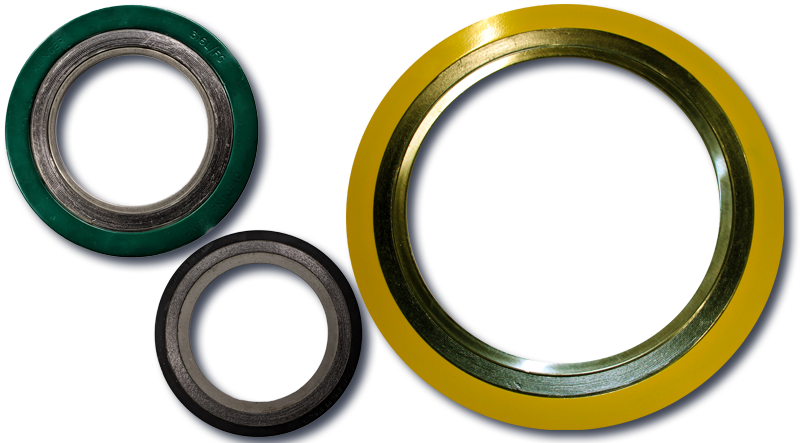
Spiral wound gaskets are typically used in applications subjected to high temperature, high pressure and toxic chemicals in areas such as petrochemical refineries and chemical processing plants. They can also be used in low temperature applications such as chemical plants, research laboratories and cryogenic facilities.
Spiral wound gaskets are most often used in pumps, pipes, valves, heat exchangers, and systems that encounter high pressures, extreme temperatures and chemical attack. Flexibility is key to the design and manufacture of spiral wound gaskets, enabling the seal to recover under extreme temperature and pressure fluctuations.
Our highly experienced technicians can advise you on the best sheet materials and manufacturing processes for a wide range of gasket applications.
We supply a vast range of gasket materials, available to buy directly or order from us. For more information visit the Gasket Sheet Materials page