
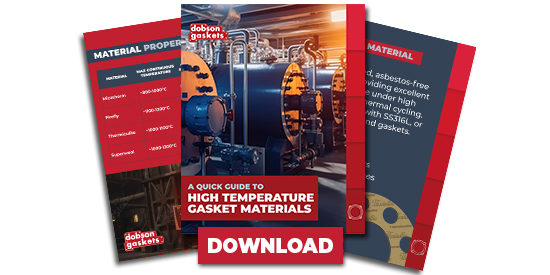
High-temperature gasket materials are designed to withstand continuous exposure to temperatures ranging from around 250°C to well over 1,000°C, depending on the material and application.
They are commonly specified for steam systems, boilers, heat exchangers, furnaces, exhaust systems, turbines, petrochemical processing and power generation equipment where thermal cycling and high flange loads place significant demands on the seal.
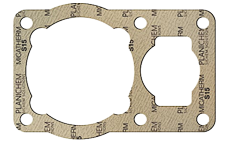
Micatherm is a rigid mica-based gasket material bonded with a SS316L tanged core. It offers excellent thermal stability, electrical insulation, and resistance to oxidation at high temperatures.
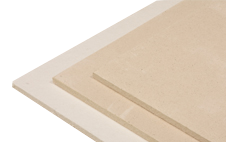
Firefly non-asbestos mill board is a high-temperature flexible sealing material designed to maintain integrity in extreme heat and direct flame environments.
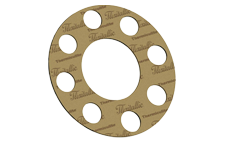
Thermiculite is a vermiculite-based, asbestos-free gasket material providing excellent sealing performance under high temperatures and thermal cycling. Available reinforced with SS316L, or as filler for spiral wound gaskets.

A low bio-persistence fibre material offering lightweight, highly compressible insulation and sealing at elevated temperatures. Superwool is a low-risk replacement for older Ceramic paper seals.
Selecting the correct gasket material for elevated temperatures requires balancing thermal stability, compressive strength, chemical compatibility, oxidation resistance and resistance to long-term creep relaxation.
As operating temperatures increase, gasket materials are subjected to thermal expansion, fluctuating bolt loads and accelerated material ageing, all of which can reduce sealing stress over time.
Conventional elastomeric materials rapidly lose their mechanical properties under these conditions, making specialist high-temperature sealing materials essential for maintaining gasket recovery, joint integrity and long-term leak prevention.
When specifying a high-temperature gasket, engineers should evaluate:
| Material | Typical Continuous Temperature | Key Characteristics | Typical Applications |
| Graphite | Up to 550°C in oxidising atmospheres (higher in non-oxidising conditions) | Excellent compressibility, thermal conductivity and chemical resistance | Steam systems, heat exchangers, valves |
| Mica | Up to 1,000°C | Outstanding oxidation resistance and electrical insulation | Exhaust systems, furnaces, high-temperature flanges |
| Thermiculite® | Up to 1,000°C | Vermiculite-based material with exceptional oxidation resistance, low creep relaxation and excellent sealing under thermal cycling | Exhaust systems, steam pipework, heat exchangers, petrochemical and power generation flanges |
| Superwool | Up to 1,100°C (grade dependent) | Low biopersistence AES fibre offering excellent thermal insulation and thermal shock resistance | Furnace doors, kilns, expansion joints and thermal insulation seals |
| Firefly® | Up to 1,100°C (grade dependent) | High-temperature textile and gasket material with excellent fire resistance, thermal insulation and flexibility | Fire doors, marine applications, exhaust systems, industrial ovens, furnaces, thermal barriers and expansion joints |
| Vermiculite | Up to 1,000°C | Stable under thermal cycling, asbestos-free and chemically resistant | Industrial heating equipment, exhaust manifolds and process plant |
| Spiral Wound Gaskets (Graphite Filled) |
Up to approximately 550°C | High-pressure metallic gasket with excellent recovery and blow-out resistance | Refineries, power generation, chemical processing and steam systems |
Sealing against high temp medias such as steam and exhaust emissions requires a rigid material impervious to thermal degradation over fluctuating conditions. Mica and non-asbestos fibre gaskets are typically used in these types of applications, particularly where oxygen is present and standard higher temperature materials such a graphite will fail.
Our highly experienced technicians can advise you on the best sheet materials and manufacturing processes for a wide range of gasket applications.
We supply a vast range of gasket materials, available to buy directly or order from us. For more information visit the Gasket Sheet Materials page