

Hydraulic systems depend on a simple principle: contain pressurised fluid reliably and consistently. When sealing fails, performance drops, safety risks increase, and downtime becomes costly. One of the most overlooked causes of hydraulic system sealing failure is a change in hydraulic oil specification.
Switching oil brands, moving to a synthetic fluid, or adopting biodegradable alternatives may appear straightforward, especially when the replacement is labelled “equivalent.” However, even small differences in oil composition can significantly affect hydraulic gasket compatibility and long-term seal performance. Understanding how oil interacts with seal materials is critical to preventing premature seal degradation.
Understanding Hydraulic Oils and Why Composition Matters
Hydraulic oils are often categorised by viscosity grade or performance standard, but these classifications do not guarantee chemical equivalence. Two oils sharing the same ISO VG rating may contain very different base stocks and additive systems.
Mineral oils remain the most widely used hydraulic fluids and are typically petroleum-based with blended anti-wear, anti-oxidation and corrosion-inhibiting additives. Synthetic fluids such as PAO (polyalphaolefin) and ester-based oils are selected for enhanced thermal stability and extended service life. Biodegradable hydraulic fluids, frequently ester-based, are increasingly specified for environmentally sensitive applications.
The critical variable is often the additive package. Zinc-based anti-wear agents, detergents, dispersants and anti-foam compounds can alter how a fluid interacts with elastomeric and polymer sealing materials. When oil chemistry changes, even subtly, the balance between fluid and seal material may shift.
Hydraulic Oil Compatibility Matrix
The table below provides a generalised compatibility overview between common hydraulic fluids and widely used sealing materials. Compatibility depends on specific compound formulation, additive chemistry, operating temperature and pressure conditions. Always verify with material-specific testing or manufacturer guidance.
| Seal Material | Mineral Oil Compatibility | PAO Synthetic Compatibility | Ester Synthetic Compatibility | Biodegradable Fluid Compatibility |
|---|---|---|---|---|
| NBR (Nitrile) | Excellent | Good | Moderate | Variable |
| FKM (Viton®) | Excellent | Excellent | Moderate | Good |
| EPDM | Poor | Poor | Good | Good |
| PTFE | Excellent | Excellent | Excellent | Excellent |
This matrix highlights a critical point: a seal material that performs well in mineral oil may not behave the same way in synthetic or biodegradable fluids. Hydraulic gasket compatibility must therefore be assessed in context, not assumed based on material name alone.
How Oil Composition Influences Seal Behaviour
Seal materials are engineered polymers designed to maintain elasticity, compression and chemical resistance within defined limits. When exposed to a new hydraulic oil, several forms of degradation can occur.
One common issue is uncontrolled swelling. Elastomers such as NBR and FKM may absorb components of the fluid, leading to dimensional changes. While limited swelling can be accounted for in design, excessive absorption reduces tensile strength and increases friction in dynamic applications.
In contrast, certain oils extract plasticisers or compounding agents from elastomers. This causes shrinkage, hardening and eventual embrittlement. Under cyclic pressure conditions, hardened seals are more prone to cracking and leakage.
Additive chemistry can also attack bonding agents in composite seals, compromising structural integrity. Even chemically resistant materials such as PTFE can be affected indirectly if fluid changes alter friction behaviour or pressure characteristics within the system. Seal degradation in hydraulic oil systems is therefore both a chemical and mechanical issue.
Three Distinct Reactions Of Elastomer Materials When Exposed To Hydraulic Fluids
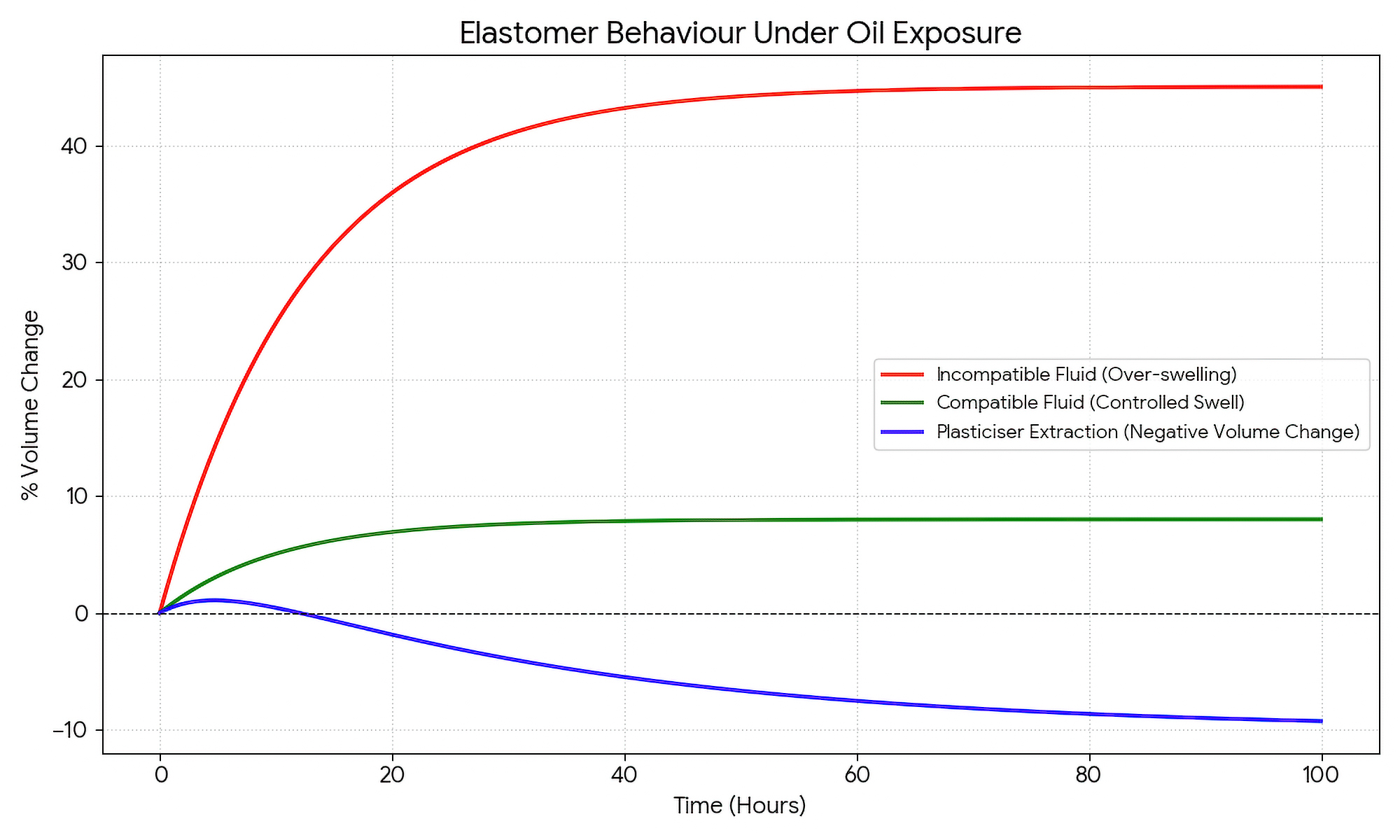
- Incompatible Fluid (Red): Shows rapid and excessive over-swelling, which can lead to seal degradation and mechanical failure.
- Compatible Fluid (Green): Displays a controlled, moderate swell that reaches a stable plateau, indicating a healthy interaction where the seal maintains its integrity.
- Plasticiser Extraction (Blue): Demonstrates a negative volume change. In this scenario, the fluid leaches out the elastomer's plasticisers more quickly than the fluid is absorbed, causing the gasket to shrink, become brittle, and eventually leak.
Engineering Oil-Compatible Sealing Solutions
Hydraulic oil changes should always prompt a review of sealing materials. True hydraulic gasket compatibility depends on compound formulation, hardness and operating conditions, not just labels such as NBR or FKM.
Dobson Gaskets works closely with engineers to assess oil compatibility with seals, review specifications and recommend upgraded materials where required. Through technical guidance and custom-manufactured solutions, we help ensure fluid changes do not lead to avoidable hydraulic system sealing failure, supporting industrial clients across the UK and internationally.
CHANGING YOUR HYDRAULIC OIL SPECIFICATION?
Talk to Our Experienced Technical Team
We design and manufacture hydraulic gaskets and seals for industrial systems, engineered for fluid compatibility, pressure and temperature performance.