
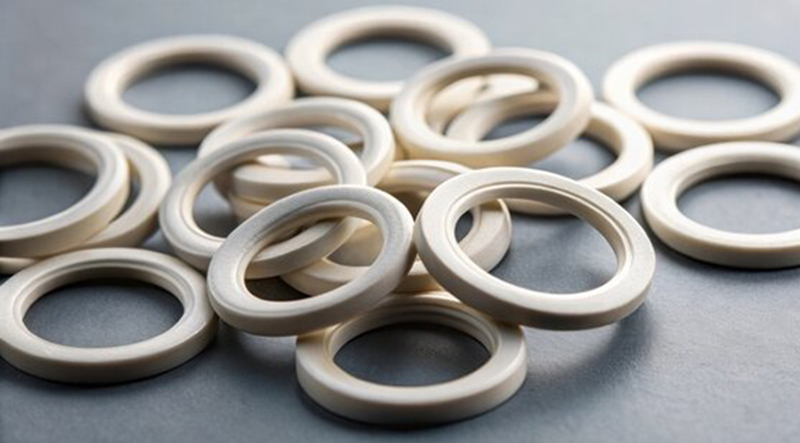
PTFE is often specified as a default sealing material for chemically aggressive environments. However, in practical engineering terms, PTFE is not a single material. Virgin PTFE, filled PTFE, and expanded PTFE (ePTFE) exhibit fundamentally different mechanical behaviours, particularly under load, over time.
Failures attributed to PTFE gaskets are frequently not material failures, but specification errors, where the wrong PTFE variant has been selected for the dominant operating risk. Understanding creep, load retention, and chemical compatibility at a material level is therefore critical to long-term sealing performance.
PTFE Gasket Performance Comparison: Virgin vs Filled vs Expanded
Material selection becomes clearer when considered in the context of the application.
Expanded PTFE is suited to low bolt load or damaged flanges due to its ability to conform to irregular surfaces. Filled PTFE performs best in high-pressure systems where load is sufficient, offering improved creep resistance and stability. In aggressive chemical environments, virgin PTFE or ePTFE is typically preferred, with creep considerations in mind.
While PTFE performs across a wide temperature range, performance depends on the balance of temperature, pressure and load. Virgin PTFE is chemically stable but mechanically weaker under pressure. Filled PTFE increases pressure capability, while expanded PTFE is better suited to moderate pressures and less controlled flange conditions.
| Performance Property | Virgin PTFE | Filled PTFE | Expanded PTFE (ePTFE) |
|---|---|---|---|
| Temperature Resistance | Excellent (typically up to ~260°C) | Excellent (filler-dependent limits) | Excellent (similar to virgin PTFE) |
| Pressure Capability | Low to moderate | High | Low to moderate |
| Creep Resistance | Poor (high cold flow) | Good to excellent (filler dependent) | Good (structure resists creep under load) |
| Compressibility | High (easily deforms) | Low to moderate (stiffer material) | High (excellent conformability at low stress) |
| Recovery | Poor | Moderate | Excellent |
| Bolt Load Retention | Poor | Good to excellent | Good |
| Flange Surface Adaptability | Moderate | Poor to moderate | Excellent |
| Chemical Resistance | Near-universal | Good, but with filler-dependent limitations | Near-universal |
| Wear Resistance | Poor | Good to excellent | Moderate |
| Typical Use Case | Highly aggressive chemicals, low mechanical stress |
High pressure, high load, stable flange conditions | Low bolt load, large flanges, poor surface finish |
Creep and Cold Flow: The Critical Limitation
Creep is the dominant failure mechanism in PTFE gasket applications. It describes the time-dependent deformation of a material under constant stress, leading to a reduction in gasket stress and eventual leakage, otherwise known as cold flow.
In practical terms, this means that even if a gasket seals effectively at installation, its performance can degrade as the material relaxes under load.
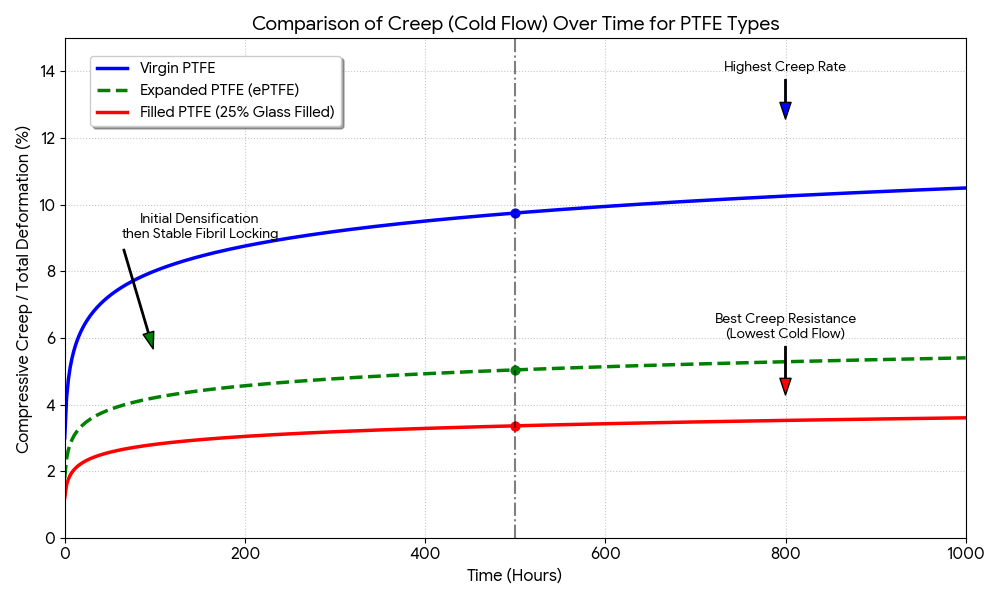
- Virgin PTFE exhibits the highest creep due to its unrestrained molecular structure. Over time, this results in a significant loss of gasket thickness and bolt preload.
- Filled PTFE reduces creep by limiting molecular mobility, improving long-term load retention.
- Expanded PTFE behaves differently. Its fibrillated structure provides mechanical resistance to creep without fillers, maintaining sealing integrity over longer periods, particularly in low to moderate load conditions.
Key Comparison of Creep Behaviour
The graph below compares how the three primary types of PTFE deform over time when held under a constant compressive load.
Virgin PTFE
Virgin PTFE exhibits the highest rate of creep. It acts similarly to a very high-viscosity liquid under sustained load, continuously deforming over time without showing a definite stop (unless the load is very low).
This rapid cold flow makes virgin PTFE unsuitable for dynamic gaskets or valve seats in systems subject to thermal cycling or high sustained pressure, as the seal will eventually flow out of the joint, leading to failure.
Filled PTFE
The addition of fillers, particularly fibres like glass in this comparison, reinforces the material to provide the best creep resistance of the three. While it still exhibits some initial deformation, the rate of continuous long-term creep is significantly reduced. This dimensional stability is crucial for high-performance sealing and bearing applications.
Expanded PTFE (ePTFE)
Expanded PTFE is highly conformable when first compressed. However, its unique fibre-and-node (fibrillated) structure gives it excellent creep properties once it is fully compressed (densified). The interlocking fibrils provide a robust mechanical structure that resists further cold flow.
While ePTFE can tolerate high initial deformation to fill surface irregularities, its long-term creep performance is generally significantly better than virgin PTFE and often approaches the stability of Filled compounds, but with superior chemical resistance and sealability.
Mechanical Behaviour Under Compression
The differences in PTFE variants become more apparent when considering how they respond to compressive stress.
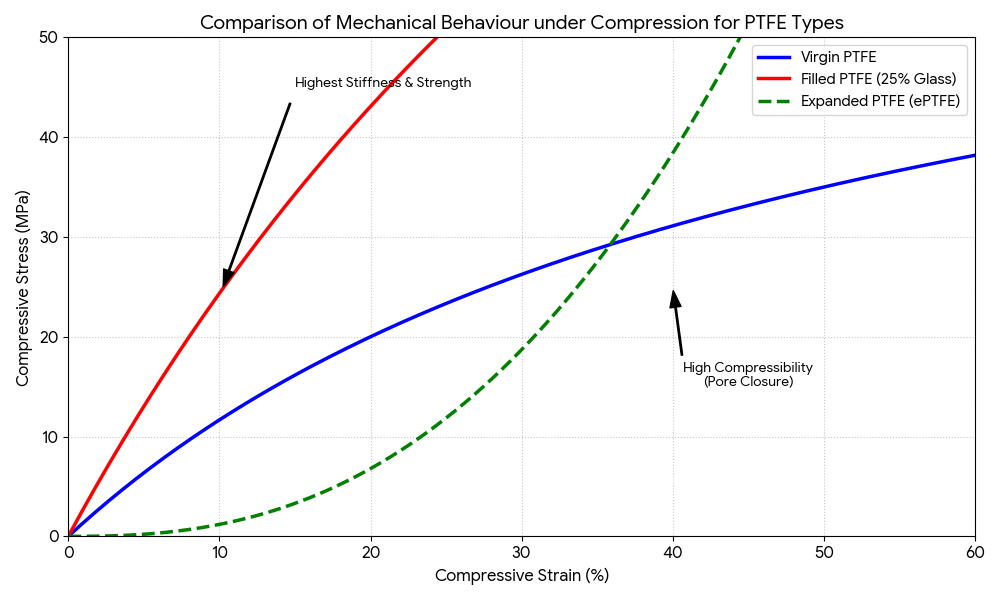
This comparison highlights three distinct behaviours:
- Virgin PTFE deforms easily, even under relatively low loads, due to its low stiffness, making it less able to maintain sealing force over time under sustained compression.
- Filled PTFE exhibits increased stiffness and a more controlled deformation profile, making it more suitable for high-load and high-pressure environments.
- Expanded PTFE demonstrates nonlinear compression. It conforms easily at low stress to achieve a seal, then resists further deformation, allowing it to maintain sealing performance even where flange conditions are imperfect.
Understanding the Role of Fillers in PTFE Performance
Filled PTFE is not a single material but a range of engineered composites, where the choice of filler directly influences mechanical strength, creep resistance, wear behaviour and chemical compatibility.
Each filler modifies the base PTFE in a different way, enhancing performance in specific operating conditions while introducing certain limitations. Comparing these variants at a filler level is essential to ensure the material is matched to the mechanical demands and chemical environment of the application.
Common Filled PTFE Variants and Their Performance Characteristics
| Filler Material | Key Mechanical Effect | Creep Resistance | Wear / Friction Behaviour | Thermal Conductivity | Chemical Considerations | Typical Applications |
|---|---|---|---|---|---|---|
| Glass Fibre | Increases stiffness and compressive strength | High | Moderate wear resistance, can be abrasive to mating surfaces | Moderate | Reduced resistance to strong alkalis and hydrofluoric acid | General industrial sealing, valves, pumps |
| Carbon | Improves strength and dimensional stability | High | Low friction, good wear resistance | High | Good chemical resistance, but can oxidise at high temperatures in air | Chemical processing, high-temperature sealing |
| Graphite | Enhances compressibility and thermal stability | Moderate to High | Excellent lubrication, low friction | High | Broad chemical resistance, but may oxidise in strong oxidising environments | Steam systems, thermal cycling applications |
| Bronze | Significantly increases compressive strength and hardness | Very High | Good wear resistance, higher friction than carbon/graphite | High | Poor resistance to corrosive chemicals, especially acids | Hydraulic systems, high-load mechanical applications |
| Mineral (Ceramic/Silica) | Improves dimensional stability with balanced properties | Moderate | Moderate wear resistance | Moderate | Generally good chemical resistance, depending on filler composition | General-purpose industrial sealing |
Selecting the Right PTFE Variant
Treating PTFE as a single material often leads to sealing failure and unnecessary maintenance. Each PTFE variant represents a different balance of mechanical and chemical performance.
Selecting the correct material requires a clear understanding of how creep, compressibility and chemical exposure interact within the application. Dobson Gaskets works closely with engineers and procurement teams to assess operating conditions and specify the most appropriate PTFE variant at a compound level.
By combining material expertise with application knowledge, we help ensure sealing reliability is designed in from the outset, rather than addressed after failure.
NEED TO SPECIFY PTFE GASKETS?
Talk to Our Experienced Technical Team
We design and manufacture PTFE gaskets and seals for demanding industrial applications, designed for chemical compatibility, pressure integrity, and temperature stability.