
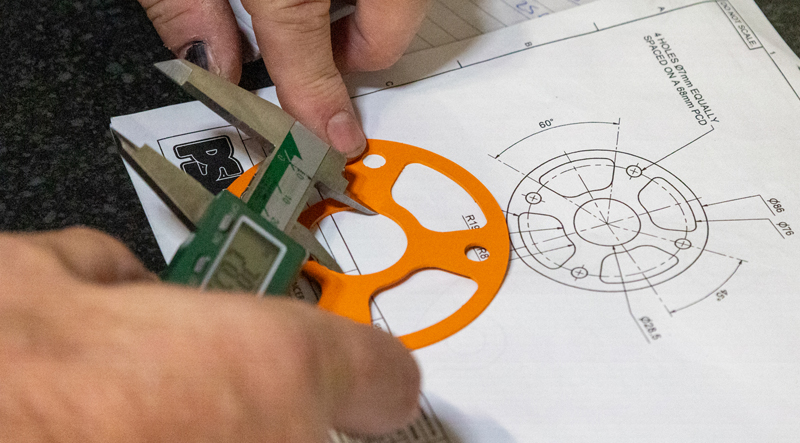
In industries where sealing performance is critical, quality cannot be left to chance. Whether a gasket is being used in automotive systems, industrial equipment, fluid handling assemblies, or heavy machinery, manufacturers and OEMs need confidence that every component will perform consistently under real-world conditions. That is where PPAP approval plays a vital role.
The Production Part Approval Process (PPAP) is designed to verify that a supplier can consistently manufacture parts that meet exact customer specifications before full-scale production begins. In gasket manufacturing, PPAPs help reduce risk, improve traceability, and ensure every sealing solution meets the required performance standards.
At Dobson Gaskets, PPAP procedures form part of a broader quality assurance framework that supports customers across a wide range of industries and applications. From material verification to dimensional inspection and process control, we carefully monitor each stage of production to ensure reliability and consistency.
What Is a PPAP?
PPAP stands for Production Part Approval Process. Originally developed within the automotive industry through AIAG standards, PPAP has become a widely adopted quality management methodology used across many sectors that require precision-manufactured components.
The purpose of a PPAP is straightforward: to demonstrate that a supplier fully understands the customer’s engineering and quality requirements and can consistently produce conforming parts during normal production conditions. Rather than relying on assumptions, PPAP approval is based on documented evidence, validated processes, and measurable inspection data.
In custom gasket manufacturing, PPAP approval may be required when:
- A new gasket design is introduced
- Materials are changed
- Tooling or manufacturing methods are updated
- Production is transferred to a different facility
- Customers require annual validation or requalification
For OEMs and industrial buyers, PPAPs provide reassurance that the gasket supplier has established stable, repeatable manufacturing processes capable of maintaining quality over time.
Why PPAPs Matter in Gasket Manufacturing
Gaskets are often critical components within larger assemblies, creating reliable seals between mating surfaces to prevent leaks, contamination, pressure loss, or system failure.
When a gasket fails, the consequences can include:
- Equipment downtime
- Product contamination
- Reduced operational efficiency
- Safety hazards
- Costly maintenance or warranty claims
Custom gasket manufacturing presents several unique challenges that make robust quality systems essential. Materials such as rubber, graphite, PTFE, fibre, sponge, and metal-backed laminates can behave differently under compression, temperature changes, and chemical exposure. Even small dimensional inconsistencies can affect sealing performance.
PPAP approval helps minimise these risks by ensuring that manufacturing processes are validated before production parts are released to customers. Our PPAP procedures help confirm that every stage of the manufacturing process, from raw material selection to final inspection, is controlled, documented, and repeatable.
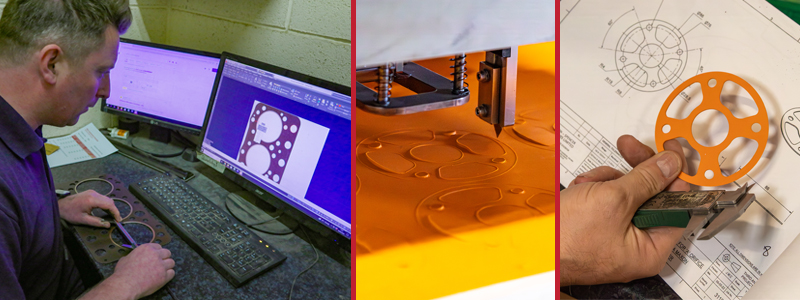
From design to production, our PPAP guarantees quality materials and reliable sealing.
The Core Elements of a Gasket PPAP
A PPAP submission is made up of multiple quality and engineering documents that collectively demonstrate process capability and product conformity. While requirements vary depending on the customer and application, a gasket PPAP typically includes several key elements.
Design Documentation
This includes customer drawings, CAD files, specifications, and revision-controlled engineering data. We maintain strict document control to ensure that manufacturing always aligns with the latest approved design revisions and customer requirements.
Material Certifications and Traceability
Material performance is fundamental to gasket reliability. PPAP documentation often includes:
- Raw material certifications
- Batch traceability records
- Compliance documentation
- Material test data
Dobson Gaskets works with approved material suppliers to ensure consistent material quality and full traceability throughout production. This is especially important in industries where chemical resistance, thermal stability, or regulatory compliance are critical.
Process Flow Documentation
Our process flow diagrams outline every stage of gasket production, including:
- Material receiving
- Cutting or die-cutting
- Lamination
- Adhesive application
- Inspection
- Packaging
By documenting the production flow, we can identify potential risks and ensure quality controls are applied at appropriate stages.
PFMEA (Process Failure Mode and Effects Analysis)
We use PFMEA to identify possible manufacturing failures before they occur. In gasket production, this may include risks such as:
- Incorrect material thickness
- Tool wear affecting dimensional accuracy
- Misaligned laminations
- Surface contamination
- Incomplete adhesive bonding
Proactive risk assessment helps minimise process variation and supports continuous improvement throughout production.
Control Plans
Our control plans define how quality is monitored during manufacturing. This typically includes:
- Inspection frequencies
- Measurement methods
- Critical dimensions
- Operator responsibilities
- Reaction plans for non-conformance
These structured controls help ensure consistency from one production batch to the next.
Quality Assurance Throughout the PPAP Process
PPAP approval is only effective when supported by strong quality assurance procedures. At Dobson Gaskets, QA processes are integrated throughout our production workflow to ensure both compliance and long-term reliability.
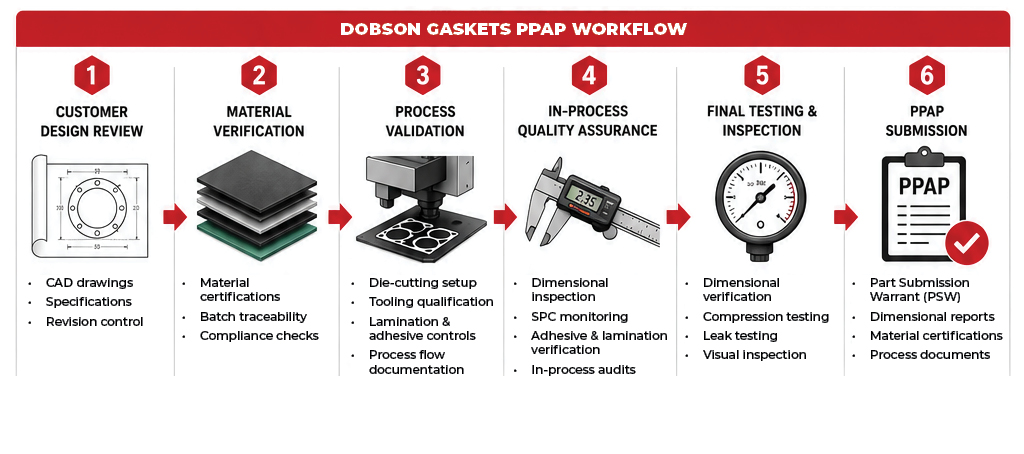
Quality Assurance as a Long-Term Commitment
PPAP approval is not simply a one-time exercise. It reflects an ongoing commitment to process control, continuous improvement, and manufacturing consistency. At Dobson Gaskets, quality assurance is embedded throughout our production process, from material selection and engineering review to inspection, documentation, and final validation.
By combining technical expertise with structured quality systems, we help customers achieve dependable sealing performance across demanding industrial applications. Our rigorous quality assurance procedures and PPAP-supported processes help ensure that every gasket is manufactured to meet the highest standards of consistency, traceability, and performance.
This article references guidance and standards published by AIAG. Visit their website for more details.
NEED RELIABLE CUSTOM GASKETS?
Talk to Our Experienced Technical Team
We design and manufacture gaskets and seals for demanding industrial applications, using our PPAP processes to guarantee durable and reliable sealing.