
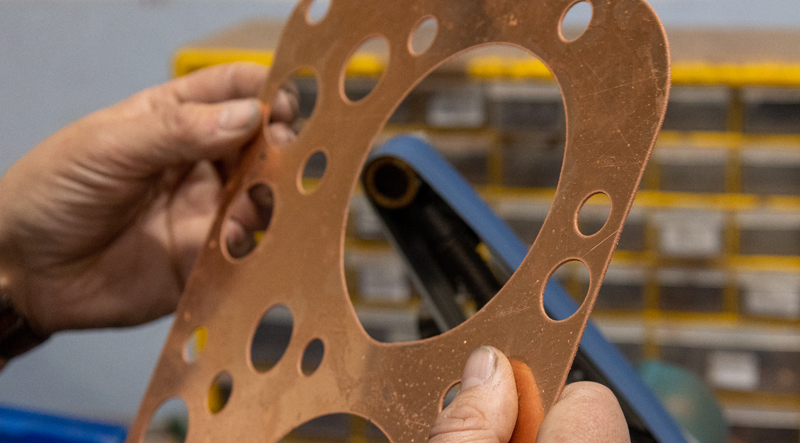
Industrial equipment often remains in service long after the original manufacturers have discontinued support. As drawings are lost, part numbers become obsolete, and suppliers disappear, sourcing replacement gaskets can become a major challenge for maintenance teams, engineers and restoration specialists.
This is particularly common in industries that rely on long-life assets, including steam systems, marine equipment, pumps, compressors, heat exchangers and heritage vehicles. When replacement parts are no longer available, gasket reverse engineering provides a practical solution.
By combining material expertise, precision measurement, CAD design and modern manufacturing techniques, obsolete gaskets can be accurately recreated, extending the life of critical equipment and avoiding costly replacements.
Assessing the Original Component
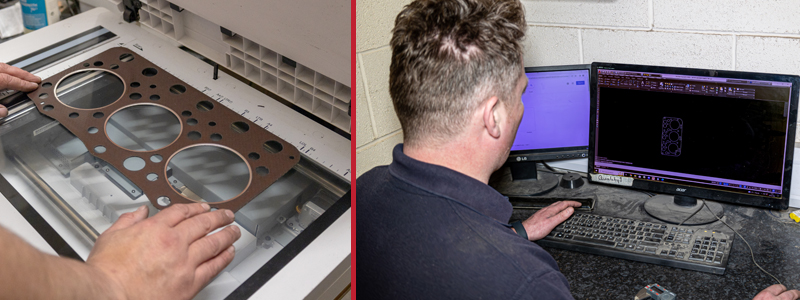
The reverse-engineering process begins with an assessment of the available information. An existing gasket can provide valuable insight into dimensions, sealing geometry and material construction, while measurements can also be taken directly from flanges, housings or mating surfaces where no sample exists.
However, experienced engineers recognise that old gaskets rarely reflect their original condition. Years of compression, temperature exposure and chemical contact can alter dimensions and material properties. Successful reverse engineering, therefore, requires an understanding of how gasket materials behave over time, rather than simply copying an existing component.
Determining the Correct Material
Material selection is one of the most important stages of the process. While dimensions determine whether a gasket fits, the material determines whether it performs reliably.
The original gasket may have been manufactured from elastomer, compressed fibre sheet, graphite, PTFE, metal or a combination of materials. Selecting the most suitable replacement requires consideration of operating temperatures, pressures, chemical exposure and installation requirements.
In some cases, the original material remains the best option. In others, modern gasket materials can improve sealing performance, chemical resistance and service life while maintaining full compatibility with the existing equipment.
Creating an Accurate Digital Design
Once dimensions and material requirements have been established, the gasket is recreated as a CAD model. This converts physical measurements into a precise engineering drawing that can be manufactured repeatedly and consistently.
Digital designs also create a permanent record of the component, enabling future replacements to be produced quickly without repeating the reverse-engineering process. Prototype templates can be manufactured, where required, to verify fit before final production.
Manufacturing Replacement Gaskets
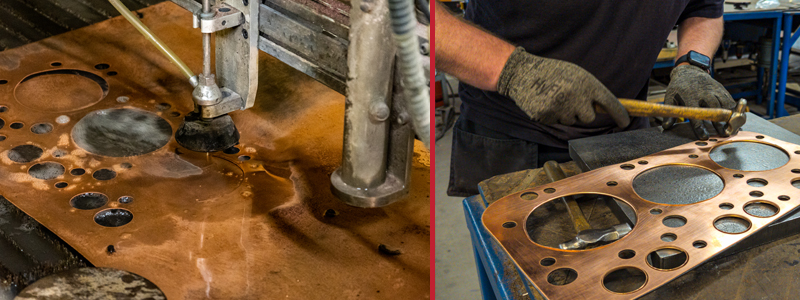
Once the design has been approved, the gasket can be manufactured using precision cutting technologies such as laser, water jet or CNC cutting, depending on the material and application.
Modern manufacturing methods not only ensure accurate reproduction of obsolete components but also provide opportunities to improve performance. By refining design features or selecting more advanced materials, it is often possible to increase chemical resistance, temperature capability and long-term sealing reliability without modifying the original equipment.
Case Study: Recreating a Head Gasket for a 1927 Crossley Tourer
A recent project demonstrates the value of reverse engineering in practice. Working with restoration specialists Long Mountain Classics, Dobson Gaskets recreated a head gasket for a 1927 Crossley 20.9 Tourer after discovering the existing component did not accurately reflect the original design.
Read the case studyQuality Assurance Remains Essential
Reverse-engineered gaskets must meet the same standards as any newly designed sealing component. Dimensional accuracy, material consistency and manufacturing control all contribute directly to sealing performance and long-term reliability.
This is particularly important in demanding environments involving elevated temperatures, high pressures or aggressive chemicals. By applying robust PPAP procedures throughout the manufacturing process, Dobson Gaskets ensures replacement components meet the performance expectations of modern industrial applications.
Extending Equipment Life Through Engineering Expertise
For more than 60 years, Dobson Gaskets has supported customers with bespoke gasket manufacturing, material selection and reverse-engineering services.
From industrial processing equipment and steam systems to marine applications and classic vehicle restoration, our team helps customers overcome complex sealing challenges when standard solutions are no longer available.
NEED RELIABLE CUSTOM GASKETS?
Talk to Our Experienced Technical Team
We design and manufacture gaskets and seals for obsolete applications that are otherwise impossible to source.