
Sealing systems operating at elevated temperatures are subjected to continuous mechanical and thermal stresses. While a gasket may provide an effective seal when first installed, its ability to maintain sealing performance can reduce over time as the material responds to prolonged loading and heat.
This is particularly common in industries that rely on long-life assets, including steam systems, marine equipment, pumps, compressors, heat exchangers and heritage vehicles. When replacement parts are no longer available, gasket reverse engineering provides a practical solution.
By combining material expertise, precision measurement, CAD design and modern manufacturing techniques, obsolete gaskets can be accurately recreated, extending the life of critical equipment and avoiding costly replacements.
One of the most common causes of long-term sealing failure in high-temperature applications is creep relaxation. Although often overlooked, this material behaviour can lead to a gradual loss of sealing stress, increasing the likelihood of leaks, maintenance interventions and unplanned downtime.
Understanding creep relaxation is essential when specifying gaskets for applications such as steam systems and boilers, heat exchangers, chemical processing equipment and high-temperature pipework.
What Is Creep Relaxation?
Creep relaxation describes the gradual reduction in sealing stress that occurs when a gasket remains under compression for an extended period, particularly at elevated temperatures.
The term combines two related material behaviours:
- Creep is the permanent deformation of a material when subjected to a constant load over time.
- Stress relaxation is the gradual reduction in the force exerted by that material while it remains compressed.
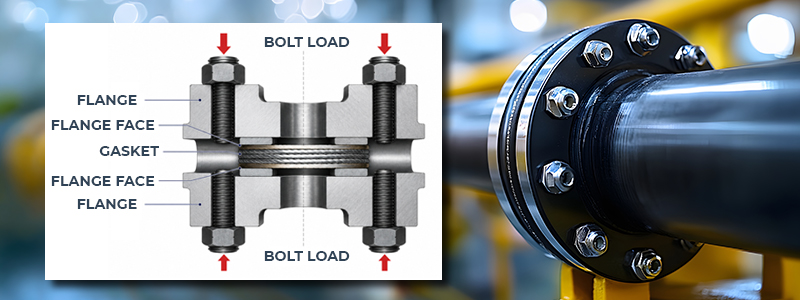
In a bolted flange joint, the gasket is compressed to create sufficient sealing stress between the mating surfaces. As the gasket creeps and relaxes, the force acting against the flange faces gradually reduces. If this sealing stress falls below the level required to contain the process media, leakage can occur even though the bolts have not loosened.
Why High Temperatures Accelerate Creep Relaxation
All gasket materials respond differently to heat, but elevated temperatures generally accelerate molecular movement within the material.
As temperature increases, polymers and binders become more susceptible to deformation under continuous load. Over time, this reduces the material's ability to recover elastically and maintain sealing stress.
The rate of creep relaxation depends on several factors, including:
- Operating temperature
- Applied bolt load
- Duration of exposure
- Internal pressure
- Chemical environment
- Material composition
For this reason, selecting a gasket based solely on its maximum temperature rating can be misleading. Two materials with similar temperature capabilities may exhibit very different long-term creep behaviour under identical operating conditions.
Which Gasket Materials Are Most Susceptible?
Different gasket materials respond differently to prolonged exposure to heat and compressive loads. Material selection should always consider the complete operating environment, including pressure, media compatibility, flange design and thermal cycling, rather than temperature alone.
Elastomer Gaskets
Elastomers provide excellent flexibility and sealing performance at moderate temperatures but gradually lose elasticity as temperatures increase. Over time, this can result in compression set and reduced sealing force, particularly in continuous high-temperature applications.
PTFE Gaskets
PTFE offers exceptional chemical resistance and is widely used in aggressive process environments. However, virgin PTFE exhibits relatively high creep under sustained loading, making gasket design and bolt loading particularly important in elevated temperature applications. Filled PTFE grades generally offer improved creep resistance.
Compressed Non-asbestos Fibre Gaskets (CNAF)
High-quality compressed fibre gasket materials provide a balanced combination of compressibility, recovery and creep resistance, making them suitable for many industrial steam and process applications when correctly specified.
Flexible Graphite Gaskets
Flexible graphite demonstrates excellent thermal stability and maintains sealing performance across a wide temperature range. Its resistance to creep relaxation makes it a preferred choice for many high-temperature flange joints, particularly in steam and refinery applications.
How Common Gasket Materials Compare for High-Temperature Sealing
The table below compares the long-term high-temperature performance of commonly specified gasket materials, including their resistance to creep relaxation, compression recovery and typical industrial applications.
|
Gasket Material |
High-Temperature Capability |
Resistance to Creep Relaxation |
Compression Recovery |
Typical Applications |
|
Low to High (compound dependent) |
Poor to Moderate |
Good initially, reduces with prolonged heat exposure |
Pumps, pipework, hydraulics, general industrial sealing |
|
|
Excellent |
Poor |
Moderate |
Chemical processing, aggressive media, pharmaceutical applications |
|
|
Excellent |
Good to Excellent |
Moderate |
Chemical processing, higher-load flange joints, corrosive environments |
|
|
Good to Excellent (grade dependent) |
Good |
Good |
Steam systems, pipe flanges, valves, pumps, general industrial plant |
|
|
Excellent |
Excellent |
Excellent |
Steam, boilers, heat exchangers, refineries, high-temperature process plant |
|
|
Excellent |
Excellent |
Excellent |
High-pressure pipework, pressure vessels, petrochemical and power generation |
Designing Against Creep Relaxation
While creep relaxation cannot be eliminated entirely, its effects can be significantly reduced through good engineering practice. Selecting a gasket material with appropriate long-term mechanical properties is the first step. However, gasket performance also depends on the complete flange assembly.
Correct gasket thickness, suitable flange surface finish, accurate bolt loading and even tightening sequences all contribute to maintaining sufficient sealing stress throughout the service life of the joint.
Where systems operate under prolonged high temperatures or thermal cycling, engineers should also consider whether modern gasket materials offer improved long-term performance compared with the original specification.
Rather than treating gasket selection as an isolated decision, the entire sealing system should be evaluated to maximise reliability.
How Dobson Gaskets Supports High-Temperature Applications
High-temperature sealing requires more than selecting a gasket with an appropriate temperature rating. Material behaviour under sustained load, chemical compatibility and long-term sealing performance must all be considered during specification.
With more than 60 years of experience, Dobson Gaskets works with engineers across manufacturing, process industries, steam generation and heavy engineering to specify gasket materials suited to demanding operating conditions.
Our team supports customers through material selection, CAD design and precision manufacturing using laser, water jet and CNC cutting technologies. By combining practical engineering knowledge with an extensive range of specialist gasket materials, we help deliver sealing solutions designed for reliable long-term performance.
NEED RELIABLE SEALING FOR HIGH-TEMPERATURE APPLICATIONS?
Talk to Our Experienced Technical Team
By combining material expertise with precision manufacturing, Dobson Gaskets helps customers specify sealing solutions that continue performing long after installation.