
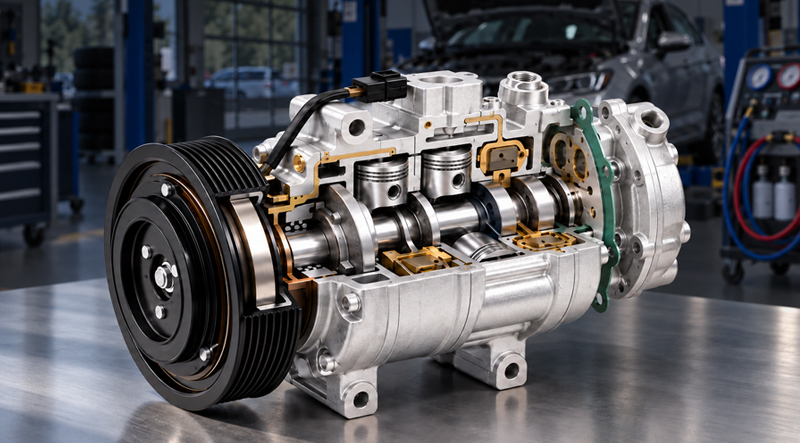
Compressor gaskets can fail before the machine’s major components because sealing depends on maintaining sufficient contact stress while pressure, temperature and mechanical loads change.
Loss of bolt preload, thermal cycling, chemical degradation, incorrect gasket thickness and damaged mating surfaces can compromise a seal while the compressor remains mechanically serviceable.
Premature failure therefore warrants an assessment of the complete joint. Replacing the gasket may restore operation, but preventing recurrence requires identifying why sealing integrity was lost.
What causes premature compressor gasket failure?
The most common mechanisms involve a combination of material behaviour, operating conditions and joint assembly:
- Loss of sealing stress: creep and stress relaxation reduce the compression holding the gasket against the mating surfaces.
- Pressure and temperature cycling: changing loads and differential thermal expansion alter contact stress.
- Material incompatibility: gases, lubricants or contaminants degrade the gasket’s mechanical properties.
- Specification or assembly errors: incorrect thickness, inaccurate profiles, surface damage or uneven bolt loading create vulnerable sealing areas.
These mechanisms can interact. A gasket weakened by chemical exposure, for example, may become more susceptible to extrusion under pressure.
Loss of sealing stress can occur without visible damage
A gasket must conform to surface irregularities during assembly and retain sufficient compressive stress throughout operation. Initial tightness does not guarantee a durable seal. Under sustained loading, gasket materials can creep and relax. In a bolted joint, this can reduce the retained clamping force, particularly at elevated temperatures. Leakage begins when local contact stress becomes insufficient to maintain tightness, even if the gasket appears intact.
Compressibility, recovery and stress relaxation therefore require separate consideration. A highly compressible material may seat readily but still perform poorly if it cannot retain load or accommodate subsequent joint movement. Selection should consider the available assembly stress, permissible gasket loading and retained sealing performance at operating temperature.
Pressure cycling challenges marginal sealing areas
Reciprocating compressors subject cylinder joints to pressure changes during each compression cycle. Loading, unloading and start-stop operation introduce additional variations. Internal pressure produces a separating force across the joint. Its effect on gasket compression depends on bolt stiffness, component stiffness and joint geometry. Where loading is already uneven, repeated pressure changes can expose a locally under-compressed area.
On head or valve-plate assemblies, a gasket may also separate suction and discharge passages. Failure across an internal sealing land can allow gas to bypass between passages without an external leak. The relevant specification is therefore more detailed than maximum discharge pressure. It includes the pressure differential across individual sealing lands and how that differential changes during operation.
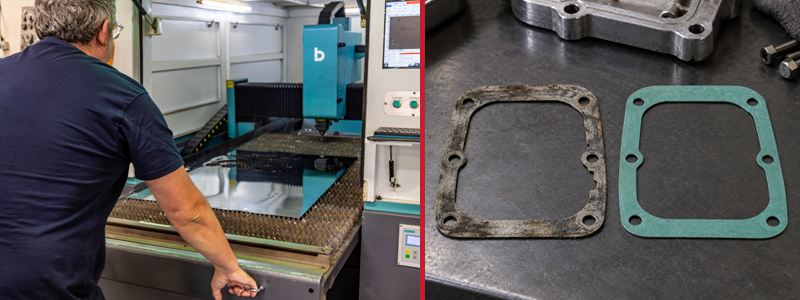
Dobson Gaskets manufactures compressor gaskets with profiles, materials and thicknesses matched to the joint and operating conditions.
Thermal cycling can undermine an otherwise suitable material
Compressor bodies, covers and fasteners expand and contract as temperatures change. Differences in material, component thickness and heating rate can redistribute contact stress across the gasket.
A material may tolerate the maximum operating temperature yet struggle to maintain a seal through repeated heating and cooling. Recovery and resistance to permanent deformation are critical where joint loading fluctuates. If gasket failures begin after a change in duty, review:
- Start-stop frequency and loaded operating periods.
- Discharge temperatures and cooling performance.
- Changes to operating pressure or compression ratio.
- The timing of leakage during warm-up, steady operation or shutdown.
A gasket that leaks only when hot or after cooling provides useful evidence about joint behaviour.
Chemical compatibility extends beyond the compressed gas
A compressor gasket may encounter lubricant, condensate, process contaminants and cleaning residues alongside the primary gas. Compatibility must account for the complete exposure at operating temperature. Depending on the gasket composition, an unsuitable fluid can cause swelling, softening, embrittlement or loss of strength. These changes affect load retention and resistance to displacement.
For refrigeration compressors, the refrigerant and lubricant combination matters. For process-gas compressors, changes in gas composition or contaminant levels may alter suitability. Descriptions such as “oil-resistant” or “suitable for compressed air” are insufficient on their own. The specific material grade must suit the actual service conditions.
Gasket thickness and profile affect machine performance
A thicker replacement is not automatically more reliable. Although additional thickness may improve conformity, it can also increase creep relaxation and susceptibility to extrusion. Conversely, reducing thickness without checking the assembly can create other problems. In some compressor designs, compressed gasket thickness contributes to component spacing or operating clearances. The specified thickness must therefore be treated as a functional dimension.
Profile accuracy is equally important. Misaligned openings, narrow sealing lands, or material projecting into a passage can compromise performance. A replacement must reproduce the internal geometry as accurately as the external perimeter. Maximum pressure and temperature ratings should also be assessed together. Their individual published limits do not necessarily apply simultaneously.
SPECIFYING THE GASKET FOR THE APPLICATION
Talk to Our Experienced Technical Team
Reliable compressor sealing depends on matching material behaviour and gasket geometry to the assembled joint and its operating conditions. Dobson Gaskets can help review your requirements and identify suitable materials and manufacturing specifications. Contact our team with your drawing, existing specification and service conditions to discuss your compressor gasket application.