
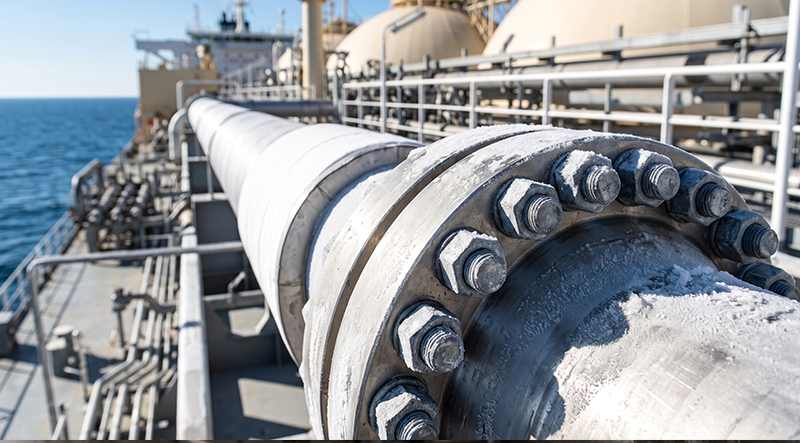
While a gasket may form an effective mechanical seal, gas molecules can still migrate through the elastomer itself, a process known as permeation. In pressure, vacuum, and controlled-atmosphere applications, even this small amount of transmission can compromise pressure stability and atmospheric integrity over time.
The consequences may emerge gradually rather than as an obvious joint failure. Equipment can require more frequent recharging, evacuation or maintenance, while sensitive processes and instruments may experience declining performance. Selecting the gasket material for its barrier properties, as well as its ability to seal the flange, is therefore an important part of long-term system reliability.
Permeation is not the same as a leaking joint
A gas-tight joint must control two fundamentally different leakage routes. Interfacial leakage occurs when gas travels between the gasket and the flange. It can be caused by insufficient gasket stress, surface damage, flange distortion, poor alignment or incorrect installation.
As established, permeation occurs through the material itself, meaning that simply increasing bolt load - which addresses interfacial leakage - will not improve your seal's barrier performance.
This distinction is important when diagnosing gradual pressure or vacuum loss. A joint may be correctly assembled and show no obvious defect, yet still lose gas slowly because the selected gasket compound has insufficient barrier performance.#
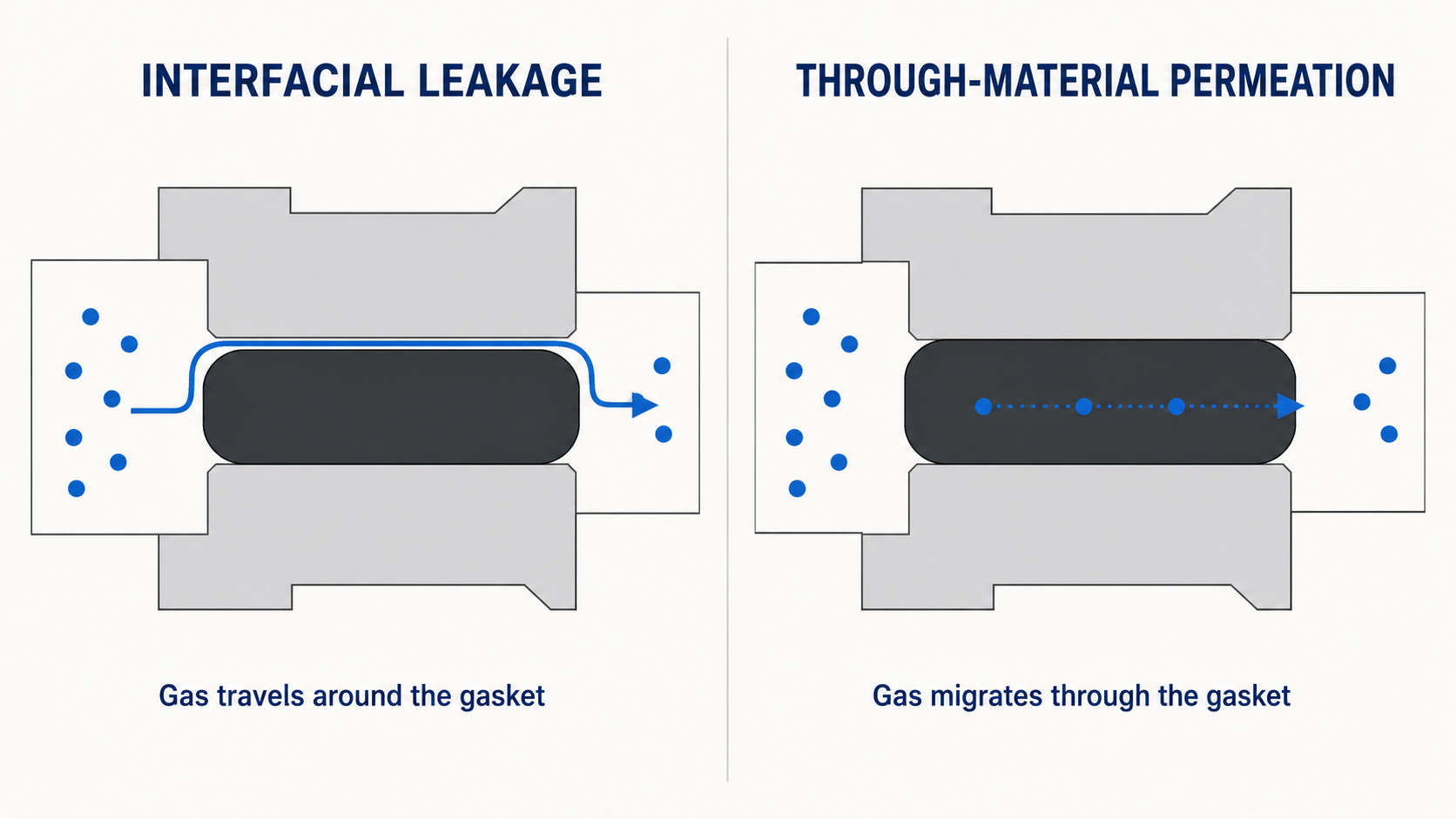
Interfacial leakage versus through-material permeation.
Specifying gaskets for low-permeability applications
The material with the lowest permeability is not automatically the best gasket for every application. Gas-barrier performance must be balanced against chemical compatibility, temperature, mechanical loading, movement and regulatory requirements.
| Material | Gas-barrier performance | Principal strengths | Important limitations |
| Butyl (IIR) | Excellent | Very low gas and moisture-vapour permeability; good ageing, ozone and weathering resistance | Generally unsuitable for petroleum oils, hydrocarbon fuels and many hydrocarbon solvents |
| Nitrile (NBR) | Good to moderate | Strong resistance to oils and fuels; widely available | Permeability varies with acrylonitrile content; limited weathering resistance without suitable protection |
| EPDM | Moderate | Excellent resistance to water, steam, ozone and outdoor weathering | Poor compatibility with petroleum oils and fuels; not normally selected primarily for minimum gas permeation |
| Natural rubber or SBR | Moderate to relatively poor | Good elasticity, abrasion performance and commercial availability | Limited resistance to oils, ozone and long-term weathering |
| Silicone | Relatively poor | Wide operating-temperature range and excellent low-temperature flexibility | High gas permeability can make it unsuitable for long-term pressure or vacuum retention |
Why butyl has low gas permeability
Butyl rubber, designated isobutylene-isoprene rubber (IIR), is a copolymer consisting primarily of isobutylene with a small proportion of isoprene. Its polymer chains pack relatively tightly and have limited molecular mobility. This restricts the rate at which gas molecules can diffuse through the material, giving butyl exceptionally low permeability compared with many commonly specified elastomers.
Butyl also offers good resistance to ageing, ozone, weathering and moisture-vapour transmission. This combination makes it particularly useful where a seal must preserve pressure, vacuum or a controlled atmosphere over an extended service interval.
Where butyl provides the clearest advantage
This low permeation rate makes butyl particularly advantageous in the following specialised environments:
Vacuum equipment
A continuous pressure differential encourages atmospheric gases to migrate towards the vacuum side of a seal. Even a small permeation rate can become relevant when equipment must maintain a vacuum for long periods.
Gas-filled electrical equipment
Switchgear, cable accessories and sealed electrical enclosures may depend on a stable internal atmosphere for insulation, contamination control or moisture management. The equipment may be expected to retain this atmosphere for years.
Pneumatic accumulators and pressure-retention devices
Analytical instruments, sensors, optical assemblies and protective enclosures may contain a dry, inert or otherwise controlled atmosphere. Gas exchange through a gasket can introduce oxygen or moisture and change conditions inside the enclosure.
Pharmaceutical and laboratory closures
Butyl compounds are also used in vial stoppers, syringe components, blood-collection closures and other applications requiring low transmission of gases and vapour.
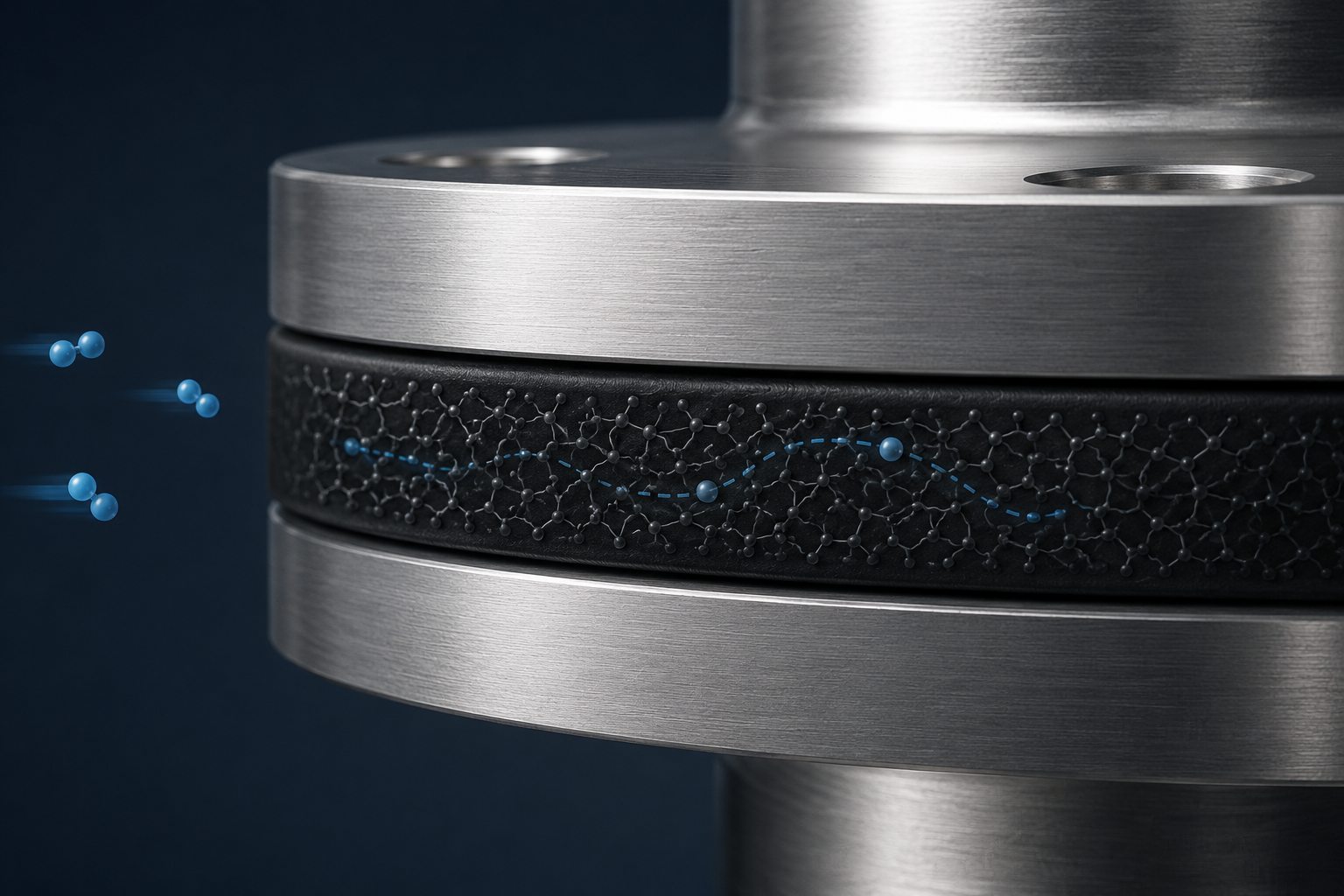
Gas permeation through a butyl gasket. Butyl’s tightly packed polymer structure restricts the movement of gas molecules through the gasket body.
When butyl is not the right choice
Butyl’s low gas permeability does not override its other material limitations. It is generally unsuitable for contact with mineral oils, petroleum fuels and many hydrocarbon solvents. Where both gas retention and hydrocarbon resistance are required, a suitably formulated nitrile, fluoroelastomer or another specialist compound may offer a better overall balance.
Operating temperature must also be considered. Gas permeation usually increases as temperature rises, while excessive heat can affect hardness, strength and compression set. The limits of the specific compound should always be checked rather than relying on a generic temperature range for the polymer family.
Dynamic service requires further scrutiny. Butyl’s relatively slow rebound may be acceptable in a static gasket but less suitable for rapidly cycling seals. Movement, flex fatigue, friction and recovery requirements must be considered alongside permeability.
What to specify
Specifying “butyl rubber” alone is not enough. Fillers, plasticisers, cure systems and processing conditions can all influence permeability, hardness, compression set, chemical resistance and ageing.
A robust gasket specification should identify:
- The gas that must be contained or excluded
- Operating and excursion temperatures
- Maximum and minimum pressures
- Required pressure or vacuum retention period
- Contact fluids, oils and chemicals
- Static or dynamic operating conditions
- Acceptable leakage or permeation rate, where critical
- Hardness and dimensional requirements
- Applicable approvals and traceability requirements
Testing should use the proposed production compound under conditions representative of the finished application. Generic polymer data is useful for initial selection but should not be treated as a guaranteed value for every commercial formulation.
Dobson Gaskets: Treating low permeability as part of the sealing system
Low permeability is only one part of effective gas sealing. Gasket material, thickness and geometry must be considered alongside flange condition, available bolt load, operating temperature, pressure differential and chemical exposure.
Dobson Gaskets can help assess these requirements and manufacture butyl gaskets to suit the application, supporting a seal that maintains pressure, vacuum or atmosphere throughout its intended service life.
NEED RELIABLE SEALING FOR PRESSURE, VACUUM AND CONTROLLED-ATMOSPHERE APPLICATIONS?
Talk to Our Experienced Technical Team
By combining material expertise with precision manufacturing, Dobson Gaskets helps customers specify sealing solutions that continue performing long after installation.